9.1 The Solar System
What's in Our Solar System?
Our Solar System consists of the Sun (a star) and all the objects that orbit it, held in place by the force of gravity.
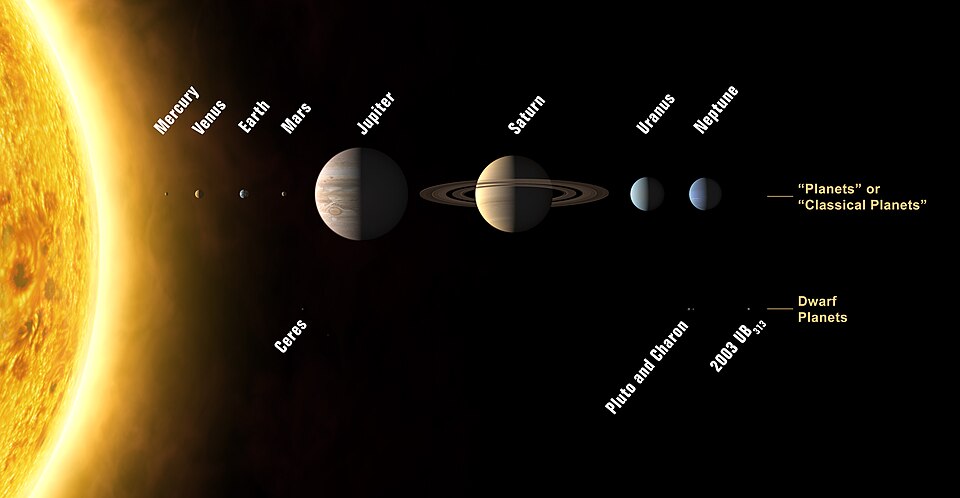
Our Solar System consists of the Sun (a star) and all the objects that orbit it, held in place by the force of gravity.
⚡ Key Concept:
An orbit is the curved path an object takes as it travels around another object.
• Gravity pulls objects towards the Sun
• Their sideways motion keeps them from falling in
• The balance creates a stable orbit
• Gravity pulls objects towards the Sun
• Their sideways motion keeps them from falling in
• The balance creates a stable orbit
☀️
The Sun
A star at the centre
🪐
Planets
8 large bodies
⚫
Dwarf Planets
e.g., Pluto
🌙
Moons
Orbit planets
🪨
Asteroids
Rock & metal
☄️
Comets
Ice & dust
Source: Wikimedia Commons

💡 Stable Orbits:
For an object to stay in a stable orbit, it must move at the correct speed:
• Too slow → Falls into the object it's orbiting
• Too fast → Flies off into space
Planets closer to the Sun orbit faster than those further away.
• Too slow → Falls into the object it's orbiting
• Too fast → Flies off into space
Planets closer to the Sun orbit faster than those further away.
🎯 Solar System Quiz:
The Eight Planets
There are eight planets in our Solar System, divided into three groups: the rocky inner planets, the gas giants, and the ice giants.
There are eight planets in our Solar System, divided into three groups: the rocky inner planets, the gas giants, and the ice giants.
⚡ Remember the Order:
My Very Easy Method Just Speeds Up Naming
Mercury, Venus, Earth, Mars, Jupiter, Saturn, Uranus, Neptune
Mercury, Venus, Earth, Mars, Jupiter, Saturn, Uranus, Neptune
🌍 Click a planet to learn more:
Mercury
Venus
Earth
Mars
Jupiter
Saturn
Uranus
Neptune
Select a planet above.
Click on any planet to see its details.
| Planet | Type | Distance from Sun | Moons |
|---|---|---|---|
| Mercury | Rocky | 58 million km | 0 |
| Venus | Rocky | 108 million km | 0 |
| Earth | Rocky | 150 million km | 1 |
| Mars | Rocky | 228 million km | 2 |
| Jupiter | Gas Giant | 778 million km | 95+ |
| Saturn | Gas Giant | 1.4 billion km | 146+ |
| Uranus | Ice Giant | 2.9 billion km | 28 |
| Neptune | Ice Giant | 4.5 billion km | 16 |
🎯 Planet Order Quiz:
From Nebula to Star
Stars are "born" from giant clouds of gas and dust called nebulae. Gravity pulls the material together over millions of years.
Stars are "born" from giant clouds of gas and dust called nebulae. Gravity pulls the material together over millions of years.
1. Nebula
A giant cloud of gas (mostly hydrogen) and dust. Gravity starts pulling material together.
2. Protostar
As gas collapses, it gets hotter and denser. The core heats up but fusion hasn't started yet.
3. Main Sequence Star
When the core reaches ~15 million °C, nuclear fusion begins. Hydrogen fuses into helium, releasing energy. Our Sun is here, it's been shining for 4.6 billion years.
⚡ Key Point:
A star spends most of its life in the main sequence stage.
• Our Sun will stay here for about 10 billion years total
• It's currently about halfway through its life
• During this time, it steadily fuses hydrogen into helium
• Our Sun will stay here for about 10 billion years total
• It's currently about halfway through its life
• During this time, it steadily fuses hydrogen into helium
🎯 Star Birth Quiz:
What Happens When Stars Die?
When a star runs out of hydrogen fuel, its fate depends on its mass. There are two main paths:
When a star runs out of hydrogen fuel, its fate depends on its mass. There are two main paths:
☀️ Sun-like Stars (Low Mass)
⭐ Main Sequence
🔴 Red Giant
🌫️ Planetary Nebula
⚪ White Dwarf
💫 Massive Stars (High Mass)
⭐ Main Sequence
🔴 Red Supergiant
💥 Supernova
🟣 Neutron Star or ⚫ Black Hole
Low Mass Stars (like our Sun):
Red Giant: The star swells up to ~100× its original size as it starts fusing helium
Planetary Nebula: Outer layers puff off into space, creating a beautiful glowing shell
White Dwarf: The hot, dense core left behind (about the size of Earth). Slowly cools over billions of years.
Planetary Nebula: Outer layers puff off into space, creating a beautiful glowing shell
White Dwarf: The hot, dense core left behind (about the size of Earth). Slowly cools over billions of years.
Massive Stars (8+ solar masses):
Red Supergiant: Grows even larger than a red giant
Supernova: The core collapses and rebounds in a massive explosion. This creates and scatters heavy elements (gold, uranium, etc.) into space
Neutron Star: An incredibly dense remnant (a teaspoon would weigh billions of tonnes)
Black Hole: If the star was massive enough, gravity is so strong that nothing can escape - not even light.
Supernova: The core collapses and rebounds in a massive explosion. This creates and scatters heavy elements (gold, uranium, etc.) into space
Neutron Star: An incredibly dense remnant (a teaspoon would weigh billions of tonnes)
Black Hole: If the star was massive enough, gravity is so strong that nothing can escape - not even light.
🌟 Star Life Cycle Simulator
Nebula
☁️
A giant cloud of gas and dust - the birthplace of stars
🎯 Star Death Quiz:
Key Points to Remember
🌍 Solar System:
• The Sun is a star at the centre
• 8 planets orbit the Sun (Mercury → Neptune)
• Inner planets are rocky, outer planets are gas/ice giants
• Orbits are maintained by the balance of gravity and speed
• Other objects: dwarf planets, moons, asteroids, comets
• 8 planets orbit the Sun (Mercury → Neptune)
• Inner planets are rocky, outer planets are gas/ice giants
• Orbits are maintained by the balance of gravity and speed
• Other objects: dwarf planets, moons, asteroids, comets
⭐ Star Life Cycles:
All stars: Nebula → Protostar → Main Sequence
Low mass (like Sun):
Main Sequence → Red Giant → Planetary Nebula → White Dwarf
High mass:
Main Sequence → Red Supergiant → Supernova → Neutron Star/Black Hole
Low mass (like Sun):
Main Sequence → Red Giant → Planetary Nebula → White Dwarf
High mass:
Main Sequence → Red Supergiant → Supernova → Neutron Star/Black Hole
💡 Did You Know?
• All the heavy elements in your body (carbon, oxygen, iron, etc.) were created inside stars.
• When massive stars explode as supernovae, they scatter these elements into space
• New stars and planets form from this enriched material
• We are literally made of "star stuff". ✨
• When massive stars explode as supernovae, they scatter these elements into space
• New stars and planets form from this enriched material
• We are literally made of "star stuff". ✨
🎯 Final Review Quiz: