9.2 Cosmology
How Movement Affects Waves
Before understanding red-shift, we need to understand the Doppler Effect - how the motion of a source affects the waves it produces.
Before understanding red-shift, we need to understand the Doppler Effect - how the motion of a source affects the waves it produces.
⚡ The Doppler Effect:
You've probably heard this with sound:
• An ambulance coming towards you → higher pitch
• An ambulance going away from you → lower pitch
The same thing happens with light.
• An ambulance coming towards you → higher pitch
• An ambulance going away from you → lower pitch
The same thing happens with light.
🔊 Doppler Effect Demonstration
See how movement changes the wavelength:
Waves at normal spacing - source is stationary
💡 For Light:
• Source moving towards you → light compressed → blue-shift (shorter wavelength)
• Source moving away from you → light stretched → red-shift (longer wavelength)
The faster the movement, the bigger the shift.
• Source moving away from you → light stretched → red-shift (longer wavelength)
The faster the movement, the bigger the shift.
🎯 Doppler Effect Quiz:
What Red-Shift Tells Us
When we observe light from distant galaxies, we find something remarkable - the light is shifted towards the red end of the spectrum.
When we observe light from distant galaxies, we find something remarkable - the light is shifted towards the red end of the spectrum.
🌈 The Electromagnetic Spectrum
Violet (short λ)
Blue
Green
Yellow
Orange
Red (long λ)
🔬 Laboratory (Earth)
Normal position of absorption lines
🌌 Distant Galaxy
Lines shifted towards the red end.
⚡ Key Discovery:
• Light from all distant galaxies is red-shifted
• This means they are all moving away from us
• The further away a galaxy is, the more red-shifted it is
• Further galaxies are moving away faster.
Conclusion: The universe is expanding.
• This means they are all moving away from us
• The further away a galaxy is, the more red-shifted it is
• Further galaxies are moving away faster.
Conclusion: The universe is expanding.
🎯 Red-Shift Quiz:
The Origin of Everything
The Big Bang Theory is the leading scientific model for the origin of the universe.
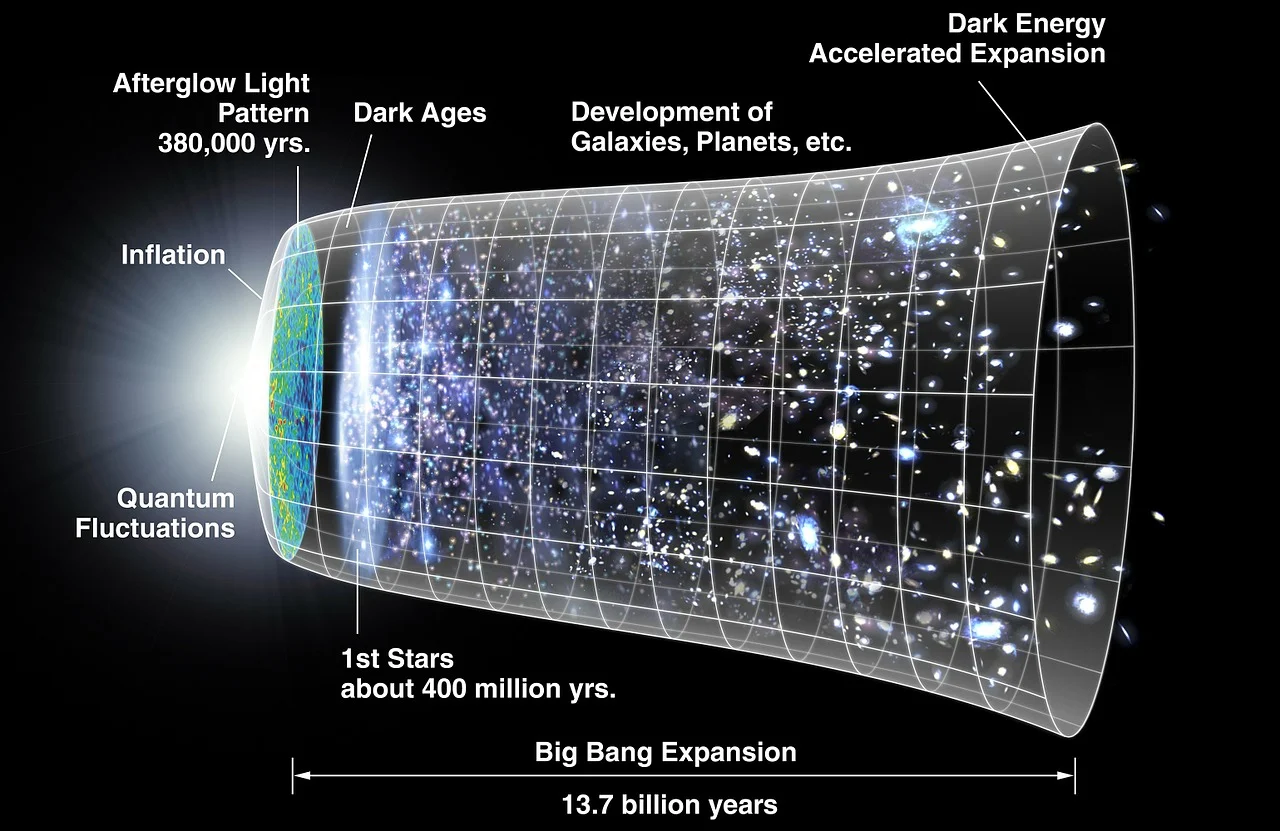
The Big Bang Theory is the leading scientific model for the origin of the universe.
⚡ The Big Bang:
• The universe began from a single, extremely hot and dense point
• This happened about 13.8 billion years ago
• Space itself began expanding (it wasn't an explosion INTO space)
• The universe has been expanding and cooling ever since
• Stars, galaxies, and everything formed as it cooled
• This happened about 13.8 billion years ago
• Space itself began expanding (it wasn't an explosion INTO space)
• The universe has been expanding and cooling ever since
• Stars, galaxies, and everything formed as it cooled
Source: Pixabay
🎈 Balloon Analogy
Imagine dots on a balloon as it inflates - all dots move apart.
Early Universe
→
Now
As the balloon expands, ALL dots move apart from each other - just like galaxies
🎯 Big Bang Quiz:
How Do We Know?
There are two key pieces of evidence that strongly support the Big Bang Theory.
There are two key pieces of evidence that strongly support the Big Bang Theory.
Red-Shift
The fact that all distant galaxies are moving away from us proves the universe is expanding - exactly as the Big Bang Theory predicts.
The further the galaxy, the faster it's receding.
CMBR
Cosmic Microwave Background Radiation - faint radiation detected everywhere in space. It's the "afterglow" of the Big Bang.
This radiation has cooled over 13.8 billion years.
⚡ What is CMBR?
• Cosmic Microwave Background Radiation
• Faint microwave radiation detected in every direction
• It's the leftover heat from the early universe
• Originally very hot, but has cooled to about -270°C (2.7 K)
• Discovered accidentally in 1965 by Penzias and Wilson
• Faint microwave radiation detected in every direction
• It's the leftover heat from the early universe
• Originally very hot, but has cooled to about -270°C (2.7 K)
• Discovered accidentally in 1965 by Penzias and Wilson
📡 Cosmic Microwave Background
The CMBR shows tiny temperature variations in the early universe.
These small differences led to the formation of galaxies.
These small differences led to the formation of galaxies.
| Evidence | What We Observe | What It Tells Us |
|---|---|---|
| Red-Shift | Light from galaxies is shifted red | Galaxies are moving away - universe expanding |
| CMBR | Faint microwaves from all directions | Leftover heat from the hot early universe |
🎯 Evidence Quiz:
Key Points to Remember
🌌 Red-Shift:
• Light from moving sources is shifted (Doppler Effect)
• Moving away → red-shift (longer wavelength)
• Moving towards → blue-shift (shorter wavelength)
• All distant galaxies show red-shift → moving away
• Further = more red-shift = moving faster
• Moving away → red-shift (longer wavelength)
• Moving towards → blue-shift (shorter wavelength)
• All distant galaxies show red-shift → moving away
• Further = more red-shift = moving faster
💥 Big Bang Theory:
• Universe began ~13.8 billion years ago
• Started as extremely hot, dense point
• Has been expanding and cooling ever since
• Space itself is expanding (not an explosion into space)
• Started as extremely hot, dense point
• Has been expanding and cooling ever since
• Space itself is expanding (not an explosion into space)
📡 Evidence:
1. Red-Shift
All galaxies moving away = universe expanding
2. CMBR (Cosmic Microwave Background Radiation)
Leftover heat from the Big Bang, detected everywhere
All galaxies moving away = universe expanding
2. CMBR (Cosmic Microwave Background Radiation)
Leftover heat from the Big Bang, detected everywhere
Did You Know?
The universe is not expanding INTO anything, space itself is stretching. There is no "outside" of the universe.
🎯 Final Review Quiz: