8.3 Nuclear Reactions
Releasing Energy from the Nucleus
Nuclear reactions release energy by changing the structure of atomic nuclei. There are two main types: fission (splitting) and fusion (joining).
Nuclear reactions release energy by changing the structure of atomic nuclei. There are two main types: fission (splitting) and fusion (joining).
⚡ Key Concept:
• Nuclear reactions release millions of times more energy than chemical reactions
• This energy comes from the mass of the nuclei (E = mc²)
• A tiny amount of mass is converted into a huge amount of energy
• This energy comes from the mass of the nuclei (E = mc²)
• A tiny amount of mass is converted into a huge amount of energy
💥 Fission
Splitting a large nucleus into smaller ones
- Large nucleus → 2 smaller nuclei
- Used in nuclear power stations
- Uranium-235 is commonly used
- Produces radioactive waste
☀️ Fusion
Joining light nuclei to form a heavier one
- 2 light nuclei → 1 heavier nucleus
- Powers the Sun and stars
- Hydrogen isotopes are used
- Produces less radioactive waste
💡 Energy Comparison:
1 kg of uranium (fission) releases as much energy as:
• ~20,000 kg of coal
• ~10,000 litres of oil
Fusion releases even MORE energy per kg than fission.
• ~20,000 kg of coal
• ~10,000 litres of oil
Fusion releases even MORE energy per kg than fission.
🎯 Fission vs Fusion Quiz:
Splitting Heavy Nuclei
Nuclear fission is the splitting of a large, unstable nucleus (like Uranium-235) into two smaller nuclei, releasing energy and neutrons.
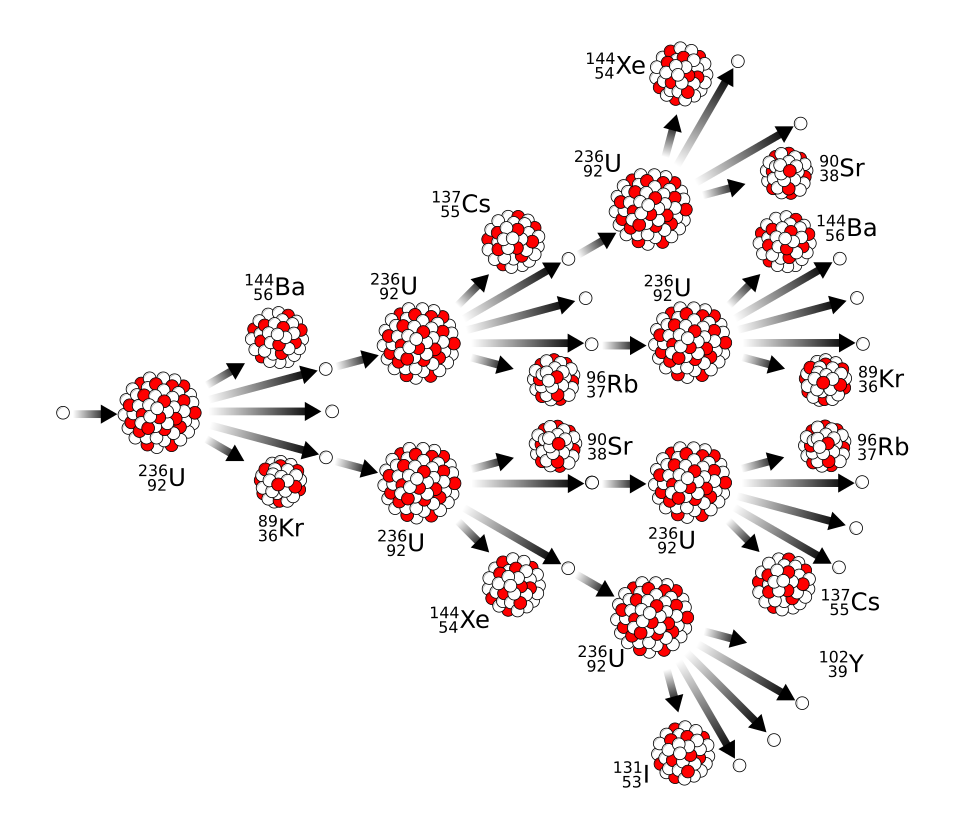
Nuclear fission is the splitting of a large, unstable nucleus (like Uranium-235) into two smaller nuclei, releasing energy and neutrons.
1
Neutron Absorbed
A slow-moving neutron is absorbed by a large, unstable nucleus (e.g., U-235)
2
Nucleus Becomes Unstable
The nucleus becomes highly unstable after absorbing the neutron
3
Nucleus Splits
The nucleus splits into two smaller "daughter" nuclei
4
Energy & Neutrons Released
A huge amount of energy is released, plus 2-3 more neutrons
Source: Wikimedia Commons

⚡ Chain Reaction:
The 2-3 neutrons released can hit other uranium nuclei, causing them to split too.
• Each fission produces more neutrons
• These neutrons cause more fissions
• This is called a chain reaction
• If uncontrolled → nuclear explosion
• If controlled → nuclear power station
• Each fission produces more neutrons
• These neutrons cause more fissions
• This is called a chain reaction
• If uncontrolled → nuclear explosion
• If controlled → nuclear power station
🎯 Fission Quiz:
Joining Light Nuclei
Nuclear fusion is the joining (fusing) of two light nuclei (like hydrogen isotopes) to form a heavier nucleus, releasing energy.
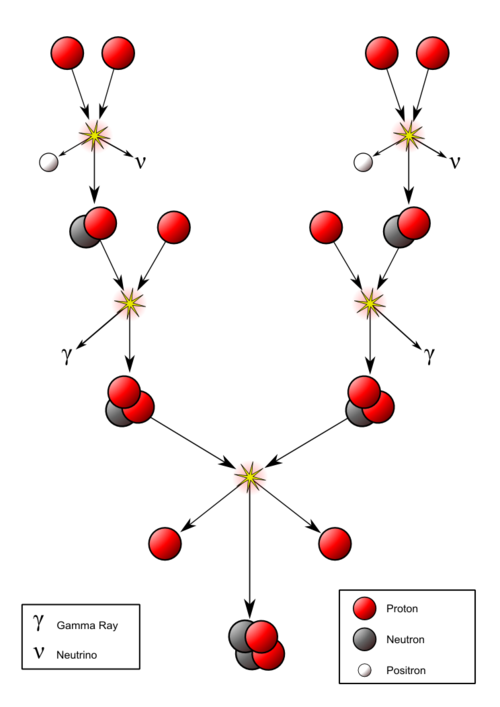
Nuclear fusion is the joining (fusing) of two light nuclei (like hydrogen isotopes) to form a heavier nucleus, releasing energy.
☀️ Powering the Sun
²H
+
³H
→
⁴He
+
n + ⚡ ENERGY
Deuterium + Tritium → Helium + Neutron + Energy
☀️
Fusion is the process that powers all the stars in the universe.
⚡ Why is Fusion Difficult?
For fusion to happen, you need:
• Extremely high temperatures (~100 million °C)
• Extremely high pressures
Why? Nuclei are positively charged (protons), so they repel each other.
You need enough energy to overcome this electrostatic repulsion and get the nuclei close enough to fuse.
• Extremely high temperatures (~100 million °C)
• Extremely high pressures
Why? Nuclei are positively charged (protons), so they repel each other.
You need enough energy to overcome this electrostatic repulsion and get the nuclei close enough to fuse.
The Fusion Challenge
Scientists are trying to build fusion reactors on Earth, but it's extremely difficult:
- How do you contain plasma at 100 million °C?
- No material can withstand these temperatures
- Current solution: magnetic confinement (tokamaks)
- We're getting closer - ITER project aims to demonstrate fusion power
| Property | Fission | Fusion |
|---|---|---|
| Process | Splitting heavy nuclei | Joining light nuclei |
| Fuel | Uranium-235, Plutonium | Hydrogen isotopes (H-2, H-3) |
| Energy per kg | Very high | Even higher |
| Conditions needed | Neutron to start reaction | Extreme temperature & pressure |
| Radioactive waste | Yes, long-lived | Much less, shorter-lived |
| Current use | Power stations (working) | Still in development |
| Where it occurs | Nuclear power plants | Stars (including our Sun) |
Source: Wikimedia Commons

🎯 Fusion Quiz:
Controlling Fission for Electricity
In a nuclear power station, the chain reaction is carefully controlled to generate heat at a steady rate.
In a nuclear power station, the chain reaction is carefully controlled to generate heat at a steady rate.
🏭 Nuclear Power Station Flow
☢️
Reactor
Heat
→
💨
Steam
Generator
→
🔄
Turbine
Spins
→
⚡
Generator
Electricity
→
🏠
Grid
Homes
⚡ Control Rods:
Control rods absorb neutrons to control the chain reaction:
• Lower the rods → absorb more neutrons → reaction slows down
• Raise the rods → absorb fewer neutrons → reaction speeds up
• If emergency → rods fully lowered → reaction stops
Control rods are usually made of boron or cadmium.
• Lower the rods → absorb more neutrons → reaction slows down
• Raise the rods → absorb fewer neutrons → reaction speeds up
• If emergency → rods fully lowered → reaction stops
Control rods are usually made of boron or cadmium.
🎛️ Control Rods in a Reactor
Reactor at normal operating level
Advantages
- No CO₂ emissions during operation
- Reliable - works day and night
- High energy output from small fuel mass
- Long operating lifetime
Disadvantages
- Radioactive waste (stored for thousands of years)
- Risk of accidents (rare but serious)
- High building and decommissioning costs
- Mining uranium has environmental impact
🎯 Power Station Quiz:
Comparing Nuclear Reactions
Both fission and fusion release enormous amounts of energy, but they work in opposite ways.
Both fission and fusion release enormous amounts of energy, but they work in opposite ways.
💥 Fission Summary
- Process: Split heavy → light
- Fuel: Uranium-235
- Products: 2 nuclei + neutrons + energy
- Chain reaction: Yes
- Status: Used in power stations
- Waste: Radioactive, long-lived
☀️ Fusion Summary
- Process: Join light → heavy
- Fuel: Hydrogen isotopes
- Products: Helium + neutron + energy
- Chain reaction: No (needs constant input)
- Status: Still being developed
- Waste: Less, shorter-lived
💡 The Future of Nuclear Energy:
Fission: Already provides ~10% of world's electricity
New designs (Gen IV reactors) aim to be safer with less waste
Fusion: The "holy grail" of energy
• Virtually unlimited fuel (hydrogen from water)
• Minimal radioactive waste
• No risk of meltdown
• But we haven't achieved sustained fusion yet.
Projects like ITER are working towards the first fusion power plants.
New designs (Gen IV reactors) aim to be safer with less waste
Fusion: The "holy grail" of energy
• Virtually unlimited fuel (hydrogen from water)
• Minimal radioactive waste
• No risk of meltdown
• But we haven't achieved sustained fusion yet.
Projects like ITER are working towards the first fusion power plants.
🎯 Final Review Quiz: