7.1 Magnetism
What is a Magnet?
A magnet is an object that produces a magnetic field. This is a region where other magnets or magnetic materials will experience a non-contact force.
A magnet is an object that produces a magnetic field. This is a region where other magnets or magnetic materials will experience a non-contact force.
⚡ Key Concept:
• All magnets have two ends called poles
• Every magnet has a North pole (N) and a South pole (S)
• You cannot have a magnet with only one pole - if you break a magnet in half, you get two smaller magnets, each with N and S poles.
• Every magnet has a North pole (N) and a South pole (S)
• You cannot have a magnet with only one pole - if you break a magnet in half, you get two smaller magnets, each with N and S poles.
North Pole (N)
N
Points towards Earth's magnetic north
Also called "north-seeking pole"
South Pole (S)
S
Points towards Earth's magnetic south
Also called "south-seeking pole"
💡 Magnetic Materials:
Only certain materials are attracted to magnets. These are called magnetic materials:
• Iron - most common magnetic material
• Steel - an alloy containing iron
• Nickel - used in coins
• Cobalt - used in strong magnets
Materials like wood, plastic, copper, and aluminium are non-magnetic.
• Iron - most common magnetic material
• Steel - an alloy containing iron
• Nickel - used in coins
• Cobalt - used in strong magnets
Materials like wood, plastic, copper, and aluminium are non-magnetic.
🔩
Iron
⚙️
Steel
🪙
Nickel
🧲
Cobalt
🪵
Wood
🥤
Plastic
🪙
Copper
🥫
Aluminium
How Magnetic Poles Interact
When two magnets are brought close together, they exert forces on each other. This is a non-contact force - they don't need to touch.
When two magnets are brought close together, they exert forces on each other. This is a non-contact force - they don't need to touch.
⚡ The Golden Rule of Magnetism:
• Like poles REPEL (push apart)
• Opposite poles ATTRACT (pull together)
N and N → Repel
S and S → Repel
N and S → Attract
• Opposite poles ATTRACT (pull together)
N and N → Repel
S and S → Repel
N and S → Attract
N
N
← →
REPEL
S
S
← →
REPEL
N
S
→ ←
ATTRACT
🧲 Magnetsss
N
S
N
S
Click "Flip" to rotate magnets and see what happens
🎯 Pole Interaction Quiz:
Permanent vs Induced Magnets
There are two main types of magnets you need to know about.
There are two main types of magnets you need to know about.
Permanent Magnet
Has its own magnetic field all the time.
Examples: Bar magnets, fridge magnets, compass needles
Made from: Steel or special alloys
Induced Magnet
Only becomes magnetic when placed in a magnetic field.
Examples: Iron nail near a magnet, paperclips in a chain
Note: Loses magnetism when removed from field
Example: Making a Chain of Paperclips
Step 1: Touch a paperclip to a permanent magnet
Step 2: The paperclip becomes an induced magnet
Step 3: This induced magnet can attract another paperclip
Step 4: You can build a chain of paperclips.
What happens when you remove the permanent magnet?
The paperclips lose their magnetism and the chain falls apart (iron loses magnetism quickly, but steel may retain some).
Step 2: The paperclip becomes an induced magnet
Step 3: This induced magnet can attract another paperclip
Step 4: You can build a chain of paperclips.
What happens when you remove the permanent magnet?
The paperclips lose their magnetism and the chain falls apart (iron loses magnetism quickly, but steel may retain some).
| Property | Permanent Magnet | Induced Magnet |
|---|---|---|
| Magnetic field | Always present | Only in another field |
| Made from | Steel, special alloys | Iron, nickel, cobalt |
| Keeps magnetism? | Yes (permanent) | Usually no |
| Examples | Bar magnet, compass | Nail, paperclip |
🎯 Magnet Type Quiz:
Visualising Magnetic Fields
A magnetic field is the region around a magnet where magnetic materials experience a force. We can draw field lines to show the shape and direction of the field.
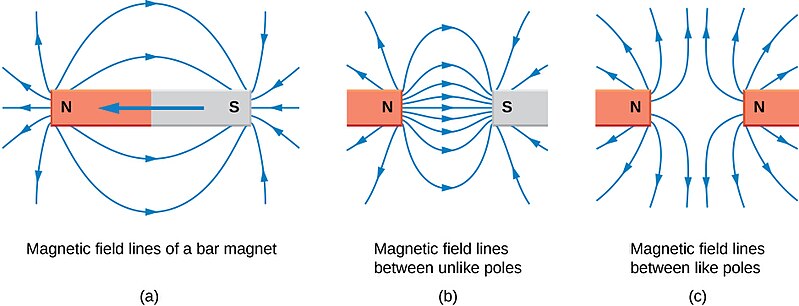
A magnetic field is the region around a magnet where magnetic materials experience a force. We can draw field lines to show the shape and direction of the field.
⚡ Rules for Magnetic Field Lines:
• Lines always go from North to South (outside the magnet)
• Lines never cross each other
• Closer lines = stronger field
• Lines show the direction a north pole would be pushed
• Lines never cross each other
• Closer lines = stronger field
• Lines show the direction a north pole would be pushed
📍 Direction
North → South outside the magnet
📏 Spacing
Closer lines = stronger field
🚫 No Crossing
Field lines never cross each other
🔄 Continuous
Lines form closed loops through the magnet
Source: Wikimedia Commons

💡 Uniform Magnetic Fields:
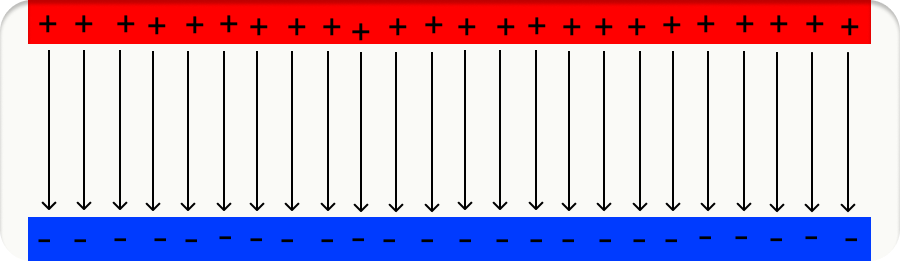
When two opposite poles (N and S) face each other, the field between them is uniform:
• Field lines are parallel and evenly spaced
• Field strength is the same everywhere between the poles
• This creates a region of constant magnetic force
• Field lines are parallel and evenly spaced
• Field strength is the same everywhere between the poles
• This creates a region of constant magnetic force
Plotting Magnetic Fields:
You can see magnetic field lines using:
1. Iron filings:
• Sprinkle iron filings around a magnet
• Each filing becomes a tiny induced magnet
• They align with the field, showing its shape
2. Plotting compass:
• Place a small compass at different points
• The needle points in the direction of the field
• Mark dots and connect them to draw field lines
1. Iron filings:
• Sprinkle iron filings around a magnet
• Each filing becomes a tiny induced magnet
• They align with the field, showing its shape
2. Plotting compass:
• Place a small compass at different points
• The needle points in the direction of the field
• Mark dots and connect them to draw field lines
🎯 Magnetic Field Quiz:
Our Planet is a Giant Magnet.
The Earth has its own magnetic field, which is why compasses work.
The Earth has its own magnetic field, which is why compasses work.
⚡ Earth's Magnetic Field:
• Earth behaves like it has a giant bar magnet inside
• The magnetic poles are near (but not exactly at) the geographic poles
• Important: Earth's magnetic north is actually a magnetic south pole.
• This is why the north pole of a compass is attracted to it
• The magnetic poles are near (but not exactly at) the geographic poles
• Important: Earth's magnetic north is actually a magnetic south pole.
• This is why the north pole of a compass is attracted to it
Example: How a Compass Works
Step 1: A compass contains a small bar magnet (the needle)
Step 2: The needle is balanced on a pivot so it can spin freely
Step 3: The north pole of the needle is attracted to Earth's magnetic field
Step 4: The needle aligns with the field, pointing north
Note: Near other magnets, the compass will point towards those instead.
Step 2: The needle is balanced on a pivot so it can spin freely
Step 3: The north pole of the needle is attracted to Earth's magnetic field
Step 4: The needle aligns with the field, pointing north
Note: Near other magnets, the compass will point towards those instead.
💡 Uses of Magnets:
• Compasses: Navigation
• Electric motors: Convert electrical energy to movement
• Generators: Convert movement to electrical energy
• Hard drives: Store digital data
• MRI scanners: Medical imaging
• Maglev trains: Frictionless transport
• Electric motors: Convert electrical energy to movement
• Generators: Convert movement to electrical energy
• Hard drives: Store digital data
• MRI scanners: Medical imaging
• Maglev trains: Frictionless transport
🎯 Earth & Compass Quiz: