6.3 Electrostatics
Static electricity is the build-up of electric charge on an object, usually an insulator (a material that does not let charge flow easily, like plastic or rubber).
• Electrons (negatively charged) are transferred from one material to the other
• The charge stays in place (static) because insulators don't let it flow away
Remember: Only electrons move, not protons.
Positive Charge (+)
Loses electrons
Has fewer electrons than protons
Negative Charge (−)
Gains electrons
Has more electrons than protons
Before rubbing: Both are neutral (equal + and − charges)
After rubbing:
• Electrons transfer from hair → balloon
• Hair becomes positively charged (lost electrons)
• Balloon becomes negatively charged (gained electrons)
Result: Opposite charges attract, so your hair sticks to the balloon.
Neutral
+ Positive
− Negative
Charged objects exert forces on each other without touching. This is a non-contact force.
• Opposite charges ATTRACT (pull together)
+ and + → Repel
− and − → Repel
+ and − → Attract
Step 1: Rod is rubbed, gaining negative charge
Step 2: Rod brought near neutral paper
Step 3: Electrons in paper are repelled to far side
Step 4: Near side of paper becomes slightly positive
Step 5: Opposite charges attract → paper sticks to rod
Note: This is called induction - the rod induces charge separation in the paper without touching it.
When a large static charge builds up, it can discharge as a spark. This is the charge jumping through the air to a conductor or to the earth.
Danger: Sparks Near Fuel
At petrol stations, static can build up on your body or the car. A spark near flammable petrol vapours can cause an explosion.
Prevention: Touch the metal car body before touching the fuel pump to discharge safely.
Danger: Aircraft Refuelling
Aircraft can build up huge static charges during flight. Refuelling without earthing could cause a catastrophic fire.
Prevention: Aircraft are always earthed with cables before refuelling begins.
Lightning is a massive static discharge between clouds and ground
2. Bottom of cloud becomes negatively charged
3. This induces positive charge on the ground below
4. When the charge difference is large enough...
5. DISCHARGE. A massive spark (lightning) jumps between them
A single lightning bolt can be 300 million volts.
Solution: Earthing (Grounding)
Earthing provides a safe path for charge to flow away to the ground, preventing dangerous build-up.
Objects at risk (like fuel tankers, aircraft, computer equipment) are connected to the ground with a conducting wire.
| Situation | Risk | Safety Measure |
|---|---|---|
| Petrol stations | Spark ignites fuel vapour | Touch metal before filling |
| Aircraft refuelling | Fire/explosion | Earthing cables |
| Operating theatres | Spark ignites anaesthetic gases | Antistatic flooring, earthed equipment |
| Computer components | Damage to sensitive chips | Antistatic wrist straps |
An electric field is the region around a charged object where another charged object will experience a non-contact force.
• Lines show the direction a positive test charge would be pushed
• Lines point away from positive charges
• Lines point towards negative charges
• Closer lines = stronger field
📍 Direction
Field lines show which way a positive charge would move
↗️ Away from +
Lines radiate outward from positive charges
↘️ Towards −
Lines point inward to negative charges
📏 Line Density
More lines packed together = stronger field
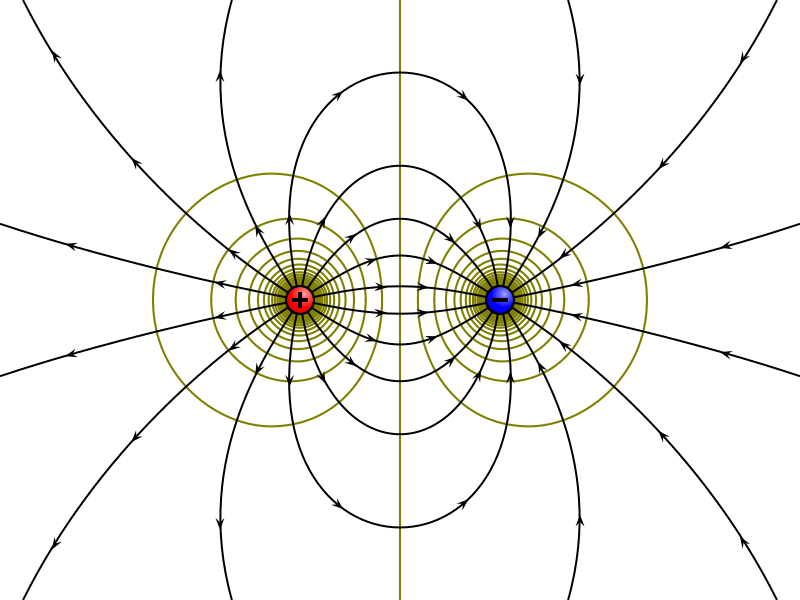
Source: Wikimedia Commons

• Field lines go from + to −
• Lines are curved, meeting both charges
• Field is strongest where lines are closest (between the charges)
Between + and + (like charges):
• Field lines point away from both charges
• Lines never cross or touch
• There's a "neutral point" in the middle where the field is zero
• Field lines are parallel and evenly spaced
• Field strength is the same everywhere between the plates
• Lines go from the positive plate to the negative plate
This is used in devices like capacitors and particle accelerators.
Static electricity isn't just dangerous - it has many useful applications.
2. Light removes charge where the image should be white
3. Negatively charged toner (ink powder) sticks to positive areas
4. Paper is given a stronger positive charge
5. Toner transfers to paper and is heat-sealed
2. The object being painted is given a positive charge (or earthed)
3. Paint is attracted to all surfaces, even the back.
4. Result: Even coating with less wasted paint
Benefits: Less waste, better coverage, even coating on complex shapes
1. Smoke passes through a charged grid
2. Dust and ash particles gain a negative charge
3. Particles are attracted to positively charged collector plates
4. Clean air exits the chimney
5. Particles are periodically shaken off and collected
This removes up to 99% of particulate pollution.
| Application | How Static is Used | Benefit |
|---|---|---|
| Photocopiers | Charge attracts toner to paper | Quick, clean copies |
| Paint spraying | Opposite charges attract paint to object | Even coating, less waste |
| Precipitators | Charged particles attracted to plates | Removes pollution |
| Inkjet printers | Charged ink droplets steered by electric fields | Precise printing |