7.2 Electromagnetism
Electricity Creates Magnetism
Think of electricity and magnetism as teammates. When electricity flows through a wire, it creates an invisible magnetic field around the wire. This special link is called electromagnetism.
Think of electricity and magnetism as teammates. When electricity flows through a wire, it creates an invisible magnetic field around the wire. This special link is called electromagnetism.
⚡ Key Concept:
• A current-carrying wire produces a magnetic field
• The field forms circular loops around the wire
• Reverse the current direction → reverse the field direction
• No current = no magnetic field (unlike permanent magnets)
• The field forms circular loops around the wire
• Reverse the current direction → reverse the field direction
• No current = no magnetic field (unlike permanent magnets)
💡 Making Electromagnets Stronger:
You can increase the magnetic field strength by:
• Increasing the current - more electrons flowing = stronger field
• Adding more coils - wind the wire into a solenoid
• Adding an iron core - put soft iron inside the coils
• Increasing the current - more electrons flowing = stronger field
• Adding more coils - wind the wire into a solenoid
• Adding an iron core - put soft iron inside the coils
⚡
Increase Current
More amps = stronger field
🔄
More Coils
Solenoid concentrates the field
🔩
Iron Core
Greatly amplifies the field
Source: Wikimedia Commons

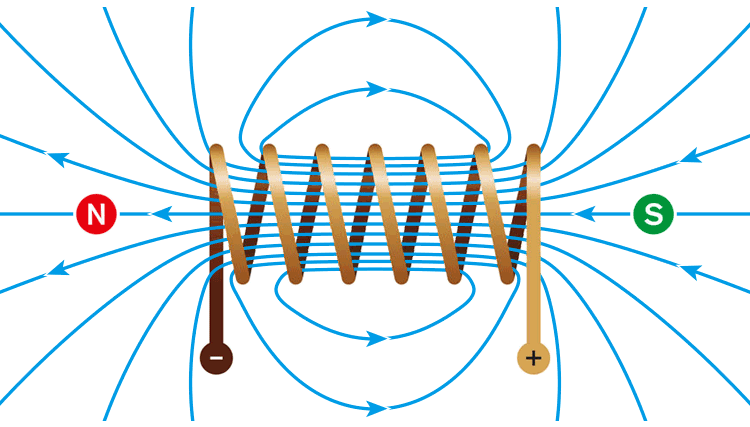
Above is a picture of a solenoid - coils of wire with current flowing through. This creates a magnetic field as indicated by the field lines, similar to a bar magnet.
Example: Solenoid Field Pattern
A solenoid creates a magnetic field that:
• Is strong and uniform inside the coil
• Looks like a bar magnet from outside
• Has a North pole at one end and South pole at the other
• Can be switched on and off by controlling the current
Uses: Electromagnets in scrapyard cranes, door bells, MRI machines
• Is strong and uniform inside the coil
• Looks like a bar magnet from outside
• Has a North pole at one end and South pole at the other
• Can be switched on and off by controlling the current
Uses: Electromagnets in scrapyard cranes, door bells, MRI machines
🎯 Electromagnet Quiz:
Force on a Current-Carrying Wire
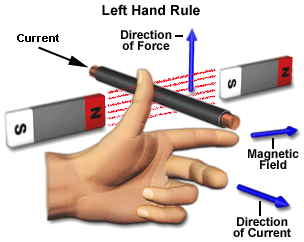
The motor effect is what happens when you place a current-carrying wire inside a magnetic field. The two magnetic fields interact, and the wire experiences a force (a push or pull).
The motor effect is what happens when you place a current-carrying wire inside a magnetic field. The two magnetic fields interact, and the wire experiences a force (a push or pull).
⚡ The Motor Effect:
When a wire carrying current is placed in a magnetic field:
• The wire's field and the external field interact
• This produces a force on the wire
• The force is perpendicular to both the field and current
• This is the principle behind electric motors
• The wire's field and the external field interact
• This produces a force on the wire
• The force is perpendicular to both the field and current
• This is the principle behind electric motors
✋ Fleming's Left-Hand Rule
Source: Wikimedia Commons

👍 Thumb
Force (Motion)
👆 First Finger
Field (N→S)
✌️ Second Finger
Current (+→−)
Motor Effect Force Equation
$F = B \times I \times L$
Force (N) = Flux Density (T) × Current (A) × Length (m)
Example: Calculating Motor Force
A 0.2 m wire carries a current of 5 A through a magnetic field of strength 0.4 T. Calculate the force on the wire.
Step 1: Write down what you know
$B = 0.4$ T, $I = 5$ A, $L = 0.2$ m
Step 2: Use the formula
$F = B \times I \times L$
$F = 0.4 \times 5 \times 0.2$
$F = 0.4$ N
Answer: The force on the wire is 0.4 N
Step 1: Write down what you know
$B = 0.4$ T, $I = 5$ A, $L = 0.2$ m
Step 2: Use the formula
$F = B \times I \times L$
$F = 0.4 \times 5 \times 0.2$
$F = 0.4$ N
Answer: The force on the wire is 0.4 N
🧮 Motor Force Calculator:
🎯 Motor Effect Quiz:
N
N
Creating Electricity from Movement
Electromagnetic induction is the opposite of the motor effect. It is the process of creating a voltage (and potential current) by using a magnetic field and movement.
Electromagnetic induction is the opposite of the motor effect. It is the process of creating a voltage (and potential current) by using a magnetic field and movement.
Motor Effect
Electricity + Magnetism
↓
Movement (Force)
Induction
Movement + Magnetism
↓
Electricity (Voltage)
⚡ How Induction Works:
• Move a wire through a magnetic field, OR
• Move a magnet near a wire/coil
• A potential difference (voltage) is induced
• If the circuit is complete, a current flows
This is how generators and alternators work.
• Move a magnet near a wire/coil
• A potential difference (voltage) is induced
• If the circuit is complete, a current flows
This is how generators and alternators work.
Induction
N | S
COIL
0.0 V
Move the magnet to induce a voltage.
💡 Increasing Induced Voltage:
To get a bigger voltage, you can:
• Move faster - quicker movement = more voltage
• Use a stronger magnet - more field = more voltage
• Use more turns of wire - coil with more loops = more voltage
Important: If nothing is moving, no voltage is induced.
• Move faster - quicker movement = more voltage
• Use a stronger magnet - more field = more voltage
• Use more turns of wire - coil with more loops = more voltage
Important: If nothing is moving, no voltage is induced.
🎯 Induction Quiz:
Changing Voltage Levels
A transformer is a device that changes the voltage of an alternating current (AC). It does not work with DC because induction requires a changing magnetic field.
A transformer is a device that changes the voltage of an alternating current (AC). It does not work with DC because induction requires a changing magnetic field.
⚡ How Transformers Work:
• Two coils wrapped around an iron core
• Primary coil: connected to AC input
• Secondary coil: where output is taken
• AC in primary creates changing magnetic field
• This induces a voltage in the secondary coil
• Primary coil: connected to AC input
• Secondary coil: where output is taken
• AC in primary creates changing magnetic field
• This induces a voltage in the secondary coil
Transformer
Primary
100
turns
IRON CORE
Secondary
100
turns
Input: 230 V AC
Output: 230 V AC
Adjust the transformer to see how voltage changes
| Property | Step-Up Transformer | Step-Down Transformer |
|---|---|---|
| Secondary turns | More than primary | Fewer than primary |
| Output voltage | Higher than input | Lower than input |
| Output current | Lower than input | Higher than input |
| Example use | Power station → Grid | Grid → Homes (230V) |
Example: Transformer Calculation
A transformer has 200 turns on the primary and 50 turns on the secondary. If the input voltage is 400 V, what is the output voltage?
Transformer equation:
$$\frac{V_p}{V_s} = \frac{N_p}{N_s}$$
Step 1: Rearrange for $V_s$
$V_s = V_p \times \frac{N_s}{N_p}$
Step 2: Substitute values
$V_s = 400 \times \frac{50}{200} = 400 \times 0.25 = 100$ V
Answer: Output voltage is 100 V (step-down)
Transformer equation:
$$\frac{V_p}{V_s} = \frac{N_p}{N_s}$$
Step 1: Rearrange for $V_s$
$V_s = V_p \times \frac{N_s}{N_p}$
Step 2: Substitute values
$V_s = 400 \times \frac{50}{200} = 400 \times 0.25 = 100$ V
Answer: Output voltage is 100 V (step-down)
🎯 Transformer Quiz:
V
V
Transmitting Electricity Across the Country
The National Grid is the network of cables and transformers that delivers electricity from power stations to homes and businesses.
The National Grid is the network of cables and transformers that delivers electricity from power stations to homes and businesses.
🔌 The National Grid
⚡
Power Station
25,000 V
→
📈
Step-Up
400,000 V
→
🗼
Pylons
Transmission
→
📉
Step-Down
230 V
→
🏠
Homes
Safe voltage
⚡ Why Use High Voltage for Transmission?
Power = Voltage × Current ($P = V \times I$)
For the same power:
• High voltage means low current
• Low current means less energy lost as heat in the wires
• Energy loss = $I^2 \times R$ (current squared × resistance)
Result: More efficient transmission, less wasted energy.
For the same power:
• High voltage means low current
• Low current means less energy lost as heat in the wires
• Energy loss = $I^2 \times R$ (current squared × resistance)
Result: More efficient transmission, less wasted energy.
💡 Grid Safety:
• High voltage transmission lines are dangerous
• They're carried on tall pylons, away from people
• Underground cables are heavily insulated
• Step-down transformers reduce voltage to safe 230 V for homes
• Never go near fallen power lines.
• They're carried on tall pylons, away from people
• Underground cables are heavily insulated
• Step-down transformers reduce voltage to safe 230 V for homes
• Never go near fallen power lines.
🎯 National Grid Quiz: