5.2 Light & EM Spectrum
What is the EM Spectrum?
The Electromagnetic (EM) spectrum is a continuous range of waves. They are all transverse waves that transfer energy.
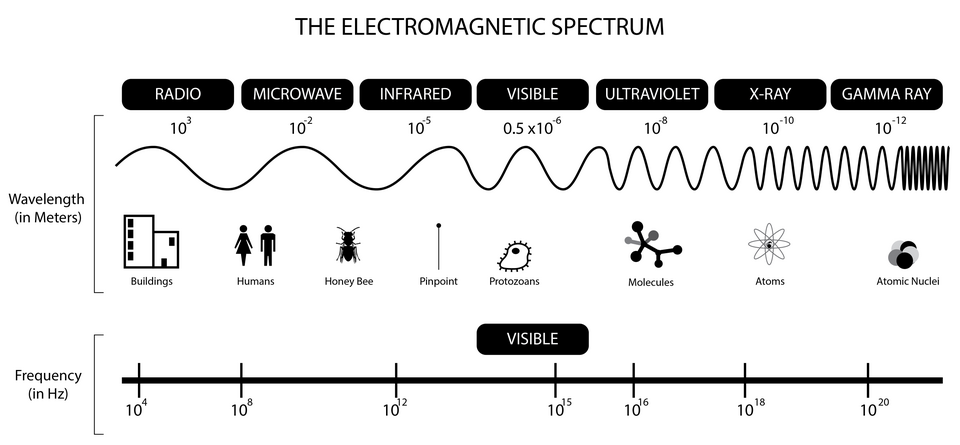
The Electromagnetic (EM) spectrum is a continuous range of waves. They are all transverse waves that transfer energy.
⚡ Key Properties of ALL EM Waves:
• All travel at the same speed in a vacuum: 300,000,000 m/s (3×10⁸ m/s)
• All are transverse waves
• Do NOT need a medium to travel
• Can travel through space
• All are transverse waves
• Do NOT need a medium to travel
• Can travel through space
💡 Memory Trick:
The Spectrum (click to explore):
Rich Men In Vegas Use X-pensive Gadgets
Radio → Microwaves → Infrared → Visible → UV → X-rays → Gamma
Radio → Microwaves → Infrared → Visible → UV → X-rays → Gamma
← Longest wavelength / Lowest frequency
Shortest wavelength / Highest frequency →
Source: Wikimedia Commons

🎯 EM Spectrum Quiz
Uses of Each EM Wave Type:
Lower energy
Cannot damage DNA directly
Can still cause burns/heating
Higher energy
Can knock electrons off atoms
Can damage DNA and cause cancer
| Wave Type | Uses | Danger Level |
|---|---|---|
| Radio waves | TV, radio broadcasting, communication | Low ✓ |
| Microwaves | Cooking food, Wi-Fi, satellite communication | Medium ⚠️ |
| Infrared | Thermal imaging, heaters, TV remotes | Medium ⚠️ |
| Visible light | Seeing, photography, fibre optics | Low ✓ |
| Ultraviolet (UV) | Sunbeds, sterilisation, security marking | High ⚠️ |
| X-rays | Medical imaging (bones), airport security | High ⚠️ |
| Gamma rays | Sterilisation, cancer treatment (radiotherapy) | Very High ⚠️ |
🚨 Dangers of EM Waves:
Higher frequency EM waves are more dangerous because they carry more energy and are ionising radiation.
Ionising means they can knock electrons off atoms, damaging DNA and causing mutations or cancer.
• Microwaves: Internal heating of body tissue
• Infrared: Skin burns
• UV: Skin cancer, eye damage (cataracts)
• X-rays & Gamma: Cell mutations, cancer
Ionising means they can knock electrons off atoms, damaging DNA and causing mutations or cancer.
• Microwaves: Internal heating of body tissue
• Infrared: Skin burns
• UV: Skin cancer, eye damage (cataracts)
• X-rays & Gamma: Cell mutations, cancer
Non-Ionising
Radio, Microwaves, Infrared, VisibleLower energy
Cannot damage DNA directly
Can still cause burns/heating
Ionising
UV, X-rays, Gamma raysHigher energy
Can knock electrons off atoms
Can damage DNA and cause cancer
🎯 Uses and Dangers Quiz
Reflection
Reflection is when a wave bounces off a surface.
Refraction is the bending of a wave as it passes from one medium to another. This happens because the wave changes speed.
• Light slows down
• Bends towards the normal
• Light speeds up
• Bends away from the normal
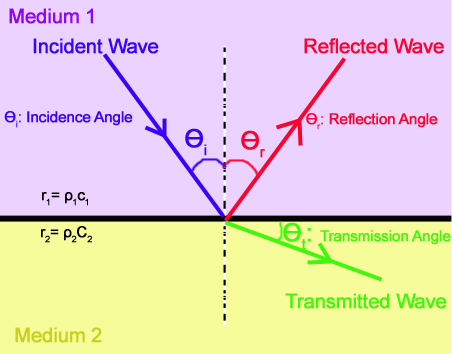
Reflection is when a wave bounces off a surface.
⚡ Law of Reflection:
Refraction
Angle of incidence (i) = Angle of reflection (r)
Both angles are measured from the normal (an imaginary line at 90° to the surface).
Both angles are measured from the normal (an imaginary line at 90° to the surface).
Refraction is the bending of a wave as it passes from one medium to another. This happens because the wave changes speed.
Into Denser Medium
(e.g., air → glass)• Light slows down
• Bends towards the normal
Into Less Dense Medium
(e.g., glass → air)• Light speeds up
• Bends away from the normal
Source: Wikimedia Commons

💡 Remember:
• The normal is always perpendicular (90°) to the surface
• Angles are measured FROM the normal, not from the surface
• When light enters glass at 90° (along the normal), it doesn't bend - just slows down
• Angles are measured FROM the normal, not from the surface
• When light enters glass at 90° (along the normal), it doesn't bend - just slows down
🎯 Reflection & Refraction Quiz
What is a Lens?
A lens is a piece of transparent material that refracts light to form an image.
• Can be projected onto a screen
• Usually inverted (upside-down)
• Formed by converging lenses
• Cannot be projected
• Always upright
• Formed by both lens types
A lens is a piece of transparent material that refracts light to form an image.
Converging (Convex)
Thicker in the middle
Brings light rays together
Can form real OR virtual images
Used in: magnifying glasses, cameras, eyes
Diverging (Concave)
Thinner in the middle
Spreads light rays apart
Always forms virtual images
Used in: short-sighted glasses, peepholes
Real Image
• Light rays actually meet• Can be projected onto a screen
• Usually inverted (upside-down)
• Formed by converging lenses
Virtual Image
• Light rays appear to come from a point• Cannot be projected
• Always upright
• Formed by both lens types
Converging Lens: Image Position
| Object Position | Image Type | Image Size | Orientation |
|---|---|---|---|
| Beyond 2F | Real | Smaller | Inverted |
| At 2F | Real | Same size | Inverted |
| Between F and 2F | Real | Larger | Inverted |
| Between lens and F | Virtual | Larger | Upright |
💡 Diverging Lens:
A diverging lens always produces:
• A virtual image
• An upright image
• A smaller image
This is true no matter where the object is placed.
• A virtual image
• An upright image
• A smaller image
This is true no matter where the object is placed.
🎬 Interactive Ray Diagram - Converging Lens:
Use the slider to build the ray diagram step by step:
Start
Step 0/6
Complete
🎬 Interactive Ray Diagram - Diverging Lens:
Use the slider to build the ray diagram step by step:
Start
Step 0/6
Complete
Drawing Ray Diagrams - Summary:
Converging Lens:
1. Draw lens, axis, and focal points (F)
2. Draw the object
3. Ray 1: Parallel to axis → through F
4. Ray 2: Through centre → no bending
5. Where rays meet = image position
Diverging Lens:
1. Draw lens, axis, and focal points (F)
2. Draw the object
3. Ray 1: Parallel to axis → appears to come from F
4. Ray 2: Through centre → no bending
5. Extend rays back (dashed) to find virtual image
1. Draw lens, axis, and focal points (F)
2. Draw the object
3. Ray 1: Parallel to axis → through F
4. Ray 2: Through centre → no bending
5. Where rays meet = image position
Diverging Lens:
1. Draw lens, axis, and focal points (F)
2. Draw the object
3. Ray 1: Parallel to axis → appears to come from F
4. Ray 2: Through centre → no bending
5. Extend rays back (dashed) to find virtual image
🎯 Lens Quiz
Real Life Applications:
• Eyes: Converging lens focuses light onto retina
• Glasses: Correct vision using converging or diverging lenses
• Cameras: Converging lens creates real image on sensor
• Projectors: Create enlarged real images
• Microscopes: Multiple lenses for magnification
• Eyes: Converging lens focuses light onto retina
• Glasses: Correct vision using converging or diverging lenses
• Cameras: Converging lens creates real image on sensor
• Projectors: Create enlarged real images
• Microscopes: Multiple lenses for magnification