5.1 Wave Properties
What is a Wave?
A wave is a vibration (oscillation) that transfers energy from one place to another without transferring matter.
A wave is a vibration (oscillation) that transfers energy from one place to another without transferring matter.
⚡ Key Point:
Waves transfer energy, not matter.
Think of a Mexican wave in a stadium - the wave travels around, but the people stay in their seats.
Think of a Mexican wave in a stadium - the wave travels around, but the people stay in their seats.
Transverse Waves
Oscillations are perpendicular (90°) to the direction of energy transfer.
⬆️⬇️ → → →
Examples:
• Light and all EM waves
• Ripples on water
• Waves on a string
Longitudinal Waves
Oscillations are parallel to the direction of energy transfer.
⬅️➡️ → → →
Examples:
• Sound waves
• Ultrasound
• P-waves (earthquakes)
💡 Longitudinal Waves: Compressions & Rarefactions
Longitudinal waves have regions where particles are:
• Compression: Particles close together (high pressure)
• Rarefaction: Particles spread apart (low pressure)
Sound travels as alternating compressions and rarefactions through air.
• Compression: Particles close together (high pressure)
• Rarefaction: Particles spread apart (low pressure)
Sound travels as alternating compressions and rarefactions through air.
🎯 Wave Type Identifier
Describing Waves
Waves can be described using several key properties:
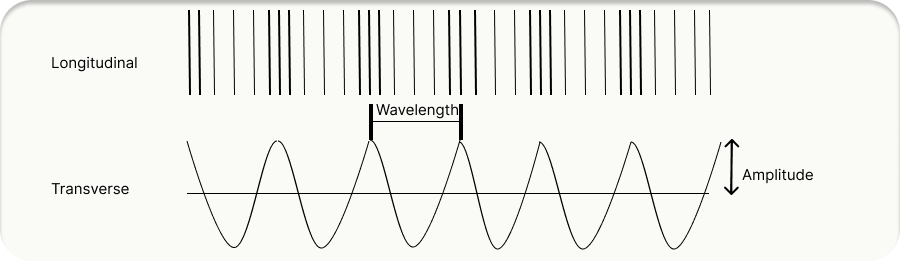
Waves can be described using several key properties:
Amplitude (A)
Maximum displacement from rest position
Related to energy
Related to energy
Wavelength (λ)
Distance of one complete wave
Measured in metres (m)
Measured in metres (m)
Frequency (f)
Waves per second
Measured in hertz (Hz)
Measured in hertz (Hz)
Time Period (T)
Time for one complete wave
Measured in seconds (s)
Measured in seconds (s)
⚡ Wave Speed Equation:
$$v = f \times \lambda$$
Where:
• $v$ = wave speed (m/s)
• $f$ = frequency (Hz)
• $\lambda$ = wavelength (m)
Also useful: $T = \frac{1}{f}$ (Period and frequency are inverses)
Where:
• $v$ = wave speed (m/s)
• $f$ = frequency (Hz)
• $\lambda$ = wavelength (m)
Also useful: $T = \frac{1}{f}$ (Period and frequency are inverses)
Example 1: Calculating Wave Speed
A wave has frequency 50 Hz and wavelength 0.4 m. Calculate its speed.
Step 1: Write the formula
$v = f \times \lambda$
Step 2: Substitute values
$v = 50 \times 0.4$
Step 3: Calculate
$v = 20$ m/s
Step 1: Write the formula
$v = f \times \lambda$
Step 2: Substitute values
$v = 50 \times 0.4$
Step 3: Calculate
$v = 20$ m/s
Example 2: Finding Wavelength
Sound travels at 340 m/s in air. What is the wavelength of a 680 Hz note?
Step 1: Rearrange the formula
$\lambda = \frac{v}{f}$
Step 2: Substitute values
$\lambda = \frac{340}{680}$
Step 3: Calculate
$\lambda = 0.5$ m
Step 1: Rearrange the formula
$\lambda = \frac{v}{f}$
Step 2: Substitute values
$\lambda = \frac{340}{680}$
Step 3: Calculate
$\lambda = 0.5$ m
Example 3: Using Period and Frequency
A wave has a period of 0.02 seconds and travels at 15 m/s. Find its wavelength.
Step 1: Find frequency
$f = \frac{1}{T} = \frac{1}{0.02} = 50$ Hz
Step 2: Find wavelength
$\lambda = \frac{v}{f} = \frac{15}{50} = 0.3$ m
Step 1: Find frequency
$f = \frac{1}{T} = \frac{1}{0.02} = 50$ Hz
Step 2: Find wavelength
$\lambda = \frac{v}{f} = \frac{15}{50} = 0.3$ m
🎯 Wave Equation Practice
What Happens When Waves Meet Boundaries?
When waves meet a boundary or different material, four things can happen:
Examples:
• Light in a mirror
• Echo (sound)
• Radar waves
Examples:
• Straw looks bent in water
• Rainbows
• Lenses focusing light
When waves meet a boundary or different material, four things can happen:
Reflected
Wave bounces back off a surface
Refracted
Wave bends as it changes speed
Transmitted
Wave passes through the material
Absorbed
Wave energy transferred to material
Reflection
Wave bounces off a surfaceExamples:
• Light in a mirror
• Echo (sound)
• Radar waves
Refraction
Wave bends when changing mediumExamples:
• Straw looks bent in water
• Rainbows
• Lenses focusing light
💡 Why Does Refraction Happen?
When a wave enters a different medium:
• The wave speed changes
• If it enters at an angle, this causes the wave to bend
• The frequency stays the same
• The wavelength changes
Rule: Wave slows down → bends towards the normal
Rule: Wave speeds up → bends away from the normal
• The wave speed changes
• If it enters at an angle, this causes the wave to bend
• The frequency stays the same
• The wavelength changes
Rule: Wave slows down → bends towards the normal
Rule: Wave speeds up → bends away from the normal
Real-World Examples:
| Behaviour | Example | What Happens |
|---|---|---|
| Reflection | Mirror | Light bounces back to show your image |
| Refraction | Swimming pool | Pool looks shallower than it is |
| Transmission | Window glass | Light passes through so you can see out |
| Absorption | Black clothing | Absorbs light and heats up in sun |
🎯 Wave Behaviour Quiz
Real Life Applications:
• Ultrasound: Uses wave reflection to image babies and organs
• Fibre optics: Uses total internal reflection to transmit data
• Glasses/contacts: Use refraction to correct vision
• Soundproofing: Uses absorption to reduce noise
• Solar panels: Absorb light energy and convert to electricity
• Ultrasound: Uses wave reflection to image babies and organs
• Fibre optics: Uses total internal reflection to transmit data
• Glasses/contacts: Use refraction to correct vision
• Soundproofing: Uses absorption to reduce noise
• Solar panels: Absorb light energy and convert to electricity