2.4 Momentum & Vehicle Safety
What is Momentum?
Momentum is a measure of how difficult it is to stop a moving object. It depends on both the object's mass and its velocity, making it a vector quantity (it has both magnitude and direction).
Momentum is a measure of how difficult it is to stop a moving object. It depends on both the object's mass and its velocity, making it a vector quantity (it has both magnitude and direction).
⚡ Key Concept:
Momentum = Mass × Velocity
p = m × v
Where:
• p is momentum in kilogram-metres per second (kg m/s)
• m is mass in kilograms (kg)
• v is velocity in metres per second (m/s)
p = m × v
Where:
• p is momentum in kilogram-metres per second (kg m/s)
• m is mass in kilograms (kg)
• v is velocity in metres per second (m/s)
💡 Why Momentum Matters:
A heavy truck and a light car traveling at the same speed have very different momentums. The truck has much more momentum and is harder to stop.
• More mass → more momentum
• More velocity → more momentum
• Double the mass OR double the velocity = double the momentum
• Momentum is what makes stopping a moving vehicle challenging.
• More mass → more momentum
• More velocity → more momentum
• Double the mass OR double the velocity = double the momentum
• Momentum is what makes stopping a moving vehicle challenging.
Small Car
Mass: 1,000 kg
Speed: 20 m/s
Momentum: 20,000 kg m/s
Large Truck
Mass: 10,000 kg
Speed: 20 m/s
Momentum: 200,000 kg m/s
🧮 Momentum Calculator:
Mass:
kg
Velocity:
m/s
Understanding Conservation of Momentum
In a closed system (where no external forces act), the total momentum before a collision or explosion is equal to the total momentum after.
In a closed system (where no external forces act), the total momentum before a collision or explosion is equal to the total momentum after.
⚡ Conservation Law:
Total Momentum Before = Total Momentum After
m₁u₁ + m₂u₂ = m₁v₁ + m₂v₂
Where:
• u = initial velocity
• v = final velocity
• Subscripts 1 and 2 refer to different objects
m₁u₁ + m₂u₂ = m₁v₁ + m₂v₂
Where:
• u = initial velocity
• v = final velocity
• Subscripts 1 and 2 refer to different objects
Example 1: Cannon and Cannonball
When a cannon fires a cannonball, the cannon recoils backwards. Why?
Before firing:
• Total momentum = 0 (nothing is moving)
After firing:
• Cannonball moves forward with momentum
• Cannon moves backward with equal momentum
• Total momentum still = 0 ✓
The forward momentum of the cannonball is equal and opposite to the backward momentum of the cannon, so the total momentum remains zero.
Before firing:
• Total momentum = 0 (nothing is moving)
After firing:
• Cannonball moves forward with momentum
• Cannon moves backward with equal momentum
• Total momentum still = 0 ✓
The forward momentum of the cannonball is equal and opposite to the backward momentum of the cannon, so the total momentum remains zero.
Example 2: Two Skaters Push Apart
Two ice skaters stand facing each other and push off.
• Skater A: mass = 60 kg, moves at 2 m/s to the right
• Skater B: mass = 80 kg
What is Skater B's velocity?
Step 1: Total momentum before = 0
(Both skaters are stationary)
Step 2: Use conservation law
Total momentum after = 0
(60 × 2) + (80 × v) = 0
120 + 80v = 0
80v = -120
v = -1.5 m/s
Answer: Skater B moves at 1.5 m/s to the left (negative indicates opposite direction)
• Skater A: mass = 60 kg, moves at 2 m/s to the right
• Skater B: mass = 80 kg
What is Skater B's velocity?
Step 1: Total momentum before = 0
(Both skaters are stationary)
Step 2: Use conservation law
Total momentum after = 0
(60 × 2) + (80 × v) = 0
120 + 80v = 0
80v = -120
v = -1.5 m/s
Answer: Skater B moves at 1.5 m/s to the left (negative indicates opposite direction)
🎯 Conservation Practice:
m/s
m/s
The Force-Momentum Relationship
Force is the rate of change of momentum. This relationship is fundamental to understanding vehicle safety.
Force is the rate of change of momentum. This relationship is fundamental to understanding vehicle safety.
⚡ Force Formula:
Force = Change in Momentum ÷ Time
F = (mv - mu) / t
Or: F = m(v - u) / t
Where:
• F = force (N)
• m = mass (kg)
• v = final velocity (m/s)
• u = initial velocity (m/s)
• t = time (s)
F = (mv - mu) / t
Or: F = m(v - u) / t
Where:
• F = force (N)
• m = mass (kg)
• v = final velocity (m/s)
• u = initial velocity (m/s)
• t = time (s)
🚨 IMPORTANT:
A large change in momentum (mv - mu) in a small time (t) creates a huge force (F).
To reduce injury in crashes:
• increase the time taken to stop
• And therefore force decreases, injury reduces ✓
To reduce injury in crashes:
• increase the time taken to stop
• And therefore force decreases, injury reduces ✓
Example 1: Car Crash Comparison
A 1,000 kg car traveling at 20 m/s crashes to a stop.
Scenario A: Hitting a wall (stops in 0.1 seconds)
F = m(v - u) / t
F = 1000(0 - 20) / 0.1
F = -20,000 / 0.1
F = 200,000 N 💀 (Extremely dangerous)
Scenario B: With crumple zones (stops in 0.5 seconds)
F = 1000(0 - 20) / 0.5
F = -20,000 / 0.5
F = 40,000 N ✓ (Much safer)
Key Point: Increasing the time by 5× reduces the force by 5×.
Scenario A: Hitting a wall (stops in 0.1 seconds)
F = m(v - u) / t
F = 1000(0 - 20) / 0.1
F = -20,000 / 0.1
F = 200,000 N 💀 (Extremely dangerous)
Scenario B: With crumple zones (stops in 0.5 seconds)
F = 1000(0 - 20) / 0.5
F = -20,000 / 0.5
F = 40,000 N ✓ (Much safer)
Key Point: Increasing the time by 5× reduces the force by 5×.
Force vs Time
Move the slider to see how stopping time affects force:
Force: 200,000 N
⚠️ Extremely Dangerous
⚠️ Extremely Dangerous
Example 2: Tennis Ball Impact
A 60 g tennis ball traveling at 30 m/s is caught by a player. The ball comes to rest in 0.05 seconds. Calculate the average force on the player's hand.
Step 1: Convert mass to kg
m = 60 g = 0.06 kg
Step 2: Identify values
• u = 30 m/s (initial)
• v = 0 m/s (final)
• t = 0.05 s
Step 3: Calculate force
F = m(v - u) / t
F = 0.06(0 - 30) / 0.05
F = -1.8 / 0.05
F = -36 N
Answer: The force is 36 N (negative indicates force opposes motion)
Step 1: Convert mass to kg
m = 60 g = 0.06 kg
Step 2: Identify values
• u = 30 m/s (initial)
• v = 0 m/s (final)
• t = 0.05 s
Step 3: Calculate force
F = m(v - u) / t
F = 0.06(0 - 30) / 0.05
F = -1.8 / 0.05
F = -36 N
Answer: The force is 36 N (negative indicates force opposes motion)
🎯 Force Calculation Practice:
N
N
How Safety Features Work
All vehicle safety features work on the same principle: increase the time taken to stop, which decreases the force on passengers.
The front and rear of cars are designed to crumple and deform during a crash.
Effect:
Increases stopping time from 0.1s to 0.5s or more
Result:
Force reduced by 5× or more ✓
Made of slightly stretchy material that extends during a crash.
Effect:
Prevents you hitting hard surfaces and increases stopping time
Result:
Spreads force over chest/hips instead of head ✓
Deploy rapidly and provide a soft cushion that deflates as you hit it.
Effect:
Increases time for head to stop
Result:
Prevents head hitting steering wheel/dashboard ✓
All vehicle safety features work on the same principle: increase the time taken to stop, which decreases the force on passengers.
⚡ Safety Feature Goal:
From F = (mv - mu) / t:
Increase t → Decrease F
Every safety feature is designed to make the collision last longer, spreading the force over more time and reducing injury.
Increase t → Decrease F
Every safety feature is designed to make the collision last longer, spreading the force over more time and reducing injury.
Crumple Zones
How they work:The front and rear of cars are designed to crumple and deform during a crash.
Effect:
Increases stopping time from 0.1s to 0.5s or more
Result:
Force reduced by 5× or more ✓
Seatbelts
How they work:Made of slightly stretchy material that extends during a crash.
Effect:
Prevents you hitting hard surfaces and increases stopping time
Result:
Spreads force over chest/hips instead of head ✓
Airbags
How they work:Deploy rapidly and provide a soft cushion that deflates as you hit it.
Effect:
Increases time for head to stop
Result:
Prevents head hitting steering wheel/dashboard ✓
Example: Comparing With and Without Safety Features
A 70 kg passenger in a car crashes at 15 m/s.
Working:
All scenarios: Change in momentum = 70 × 15 = 1,050 kg m/s
• No safety: F = 1,050 / 0.05 = 21,000 N
• Seatbelt: F = 1,050 / 0.2 = 5,250 N
• Seatbelt + Airbag: F = 1,050 / 0.5 = 2,100 N
| Scenario | Stopping Time | Force | Outcome |
|---|---|---|---|
| No Safety Features (Hit dashboard) |
0.05 s | 21,000 N | ⚠️ Severe injury likely |
| Seatbelt Only | 0.2 s | 5,250 N | ⚠️ Injury possible |
| Seatbelt + Airbag | 0.5 s | 2,100 N | ✓ Much safer |
Working:
All scenarios: Change in momentum = 70 × 15 = 1,050 kg m/s
• No safety: F = 1,050 / 0.05 = 21,000 N
• Seatbelt: F = 1,050 / 0.2 = 5,250 N
• Seatbelt + Airbag: F = 1,050 / 0.5 = 2,100 N
💡 Other Safety Features:
• Padded dashboards: Softer surface, longer contact time
• Collapsible steering columns: Collapses on impact
• Side impact bars: Protect in side collisions
• Headrests: Prevent whiplash by supporting neck
• Shatter-resistant glass: Breaks into small pieces, not shards
• Collapsible steering columns: Collapses on impact
• Side impact bars: Protect in side collisions
• Headrests: Prevent whiplash by supporting neck
• Shatter-resistant glass: Breaks into small pieces, not shards
Understanding Stopping Distance
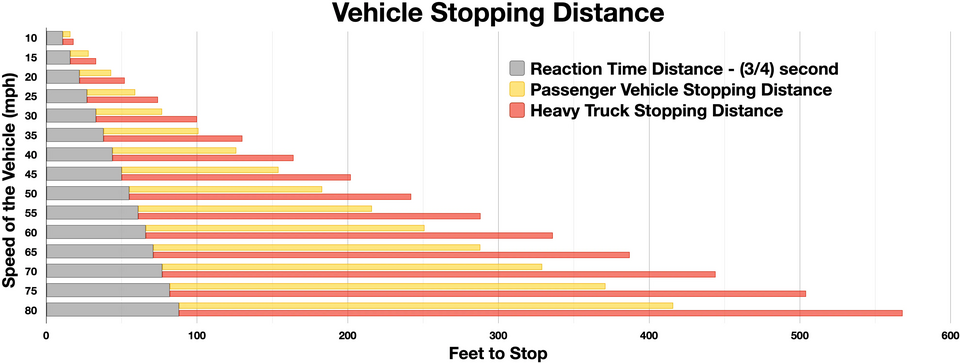
The total stopping distance is the distance a vehicle travels from when a hazard is spotted until the vehicle comes to a complete stop.
✗ Higher speed
✗ Tiredness
✗ Alcohol/drugs
✗ Distractions
✗ Poor visibility
Typical reaction time: 0.2 - 0.9 seconds
✗ Higher speed (squared relationship)
✗ Wet/icy roads
✗ Poor tire condition
✗ Poor brake condition
✗ Heavy vehicle load
Note: Speed has the biggest effect.
The total stopping distance is the distance a vehicle travels from when a hazard is spotted until the vehicle comes to a complete stop.
⚡ Stopping Distance Formula:
Stopping Distance = Thinking Distance + Braking Distance
• Thinking Distance: Distance traveled during reaction time (before brakes applied)
• Braking Distance: Distance traveled after brakes applied until stop
• Thinking Distance: Distance traveled during reaction time (before brakes applied)
• Braking Distance: Distance traveled after brakes applied until stop
Source: Wikimedia Commons

Example 1: Calculating Total Stopping Distance
A car travels at 20 m/s. The driver's reaction time is 0.7 seconds. After braking, the car takes 3 seconds to stop.
Step 1: Calculate thinking distance
Thinking distance = speed × reaction time
Thinking distance = 20 × 0.7 = 14 m
Step 2: Calculate braking distance
Average speed while braking = 20 / 2 = 10 m/s
Braking distance = 10 × 3 = 30 m
Step 3: Calculate total
Total stopping distance = 14 + 30 = 44 m
Step 1: Calculate thinking distance
Thinking distance = speed × reaction time
Thinking distance = 20 × 0.7 = 14 m
Step 2: Calculate braking distance
Average speed while braking = 20 / 2 = 10 m/s
Braking distance = 10 × 3 = 30 m
Step 3: Calculate total
Total stopping distance = 14 + 30 = 44 m
Thinking Distance Factors
Increases with:✗ Higher speed
✗ Tiredness
✗ Alcohol/drugs
✗ Distractions
✗ Poor visibility
Typical reaction time: 0.2 - 0.9 seconds
Braking Distance Factors
Increases with:✗ Higher speed (squared relationship)
✗ Wet/icy roads
✗ Poor tire condition
✗ Poor brake condition
✗ Heavy vehicle load
Note: Speed has the biggest effect.
🚨 Speed and Braking Distance:
Braking distance is proportional to speed squared:
• Double the speed → 4× the braking distance
• Triple the speed → 9× the braking distance
• Double the speed → 4× the braking distance
• Triple the speed → 9× the braking distance
| Speed (mph) | Thinking (m) | Braking (m) | Total (m) |
|---|---|---|---|
| 20 mph | 6 | 6 | 12 |
| 30 mph | 9 | 14 | 23 |
| 40 mph | 12 | 24 | 36 |
| 50 mph | 15 | 38 | 53 |
| 60 mph | 18 | 55 | 73 |
| 70 mph | 21 | 75 | 96 |
Example 2: Effect of Distractions
Compare stopping distances at 30 m/s (about 70 mph):
Alert driver (reaction time = 0.5 s):
Thinking distance = 30 × 0.5 = 15 m
Distracted driver (reaction time = 1.5 s):
Thinking distance = 30 × 1.5 = 45 m
Extra distance: 30 m - Could mean the difference between stopping safely and a collision.
Alert driver (reaction time = 0.5 s):
Thinking distance = 30 × 0.5 = 15 m
Distracted driver (reaction time = 1.5 s):
Thinking distance = 30 × 1.5 = 45 m
Extra distance: 30 m - Could mean the difference between stopping safely and a collision.
🎚️ Stopping Distance Calculator:
🎯 Stopping Distance Practice:
m
m
Applying Momentum Concepts
Example 1: Multi-Step Problem
A 1,200 kg car traveling at 25 m/s crashes into a stationary 800 kg car. They lock together after the collision. Calculate their combined velocity after the collision.
Step 1: Calculate initial momentum
Total momentum before = (1200 × 25) + (800 × 0)
Total momentum before = 30,000 kg m/s
Step 2: Use conservation of momentum
Total momentum after = Total momentum before
(1200 + 800) × v = 30,000
2000v = 30,000
v = 15 m/s
Answer: Combined velocity = 15 m/s
Step 1: Calculate initial momentum
Total momentum before = (1200 × 25) + (800 × 0)
Total momentum before = 30,000 kg m/s
Step 2: Use conservation of momentum
Total momentum after = Total momentum before
(1200 + 800) × v = 30,000
2000v = 30,000
v = 15 m/s
Answer: Combined velocity = 15 m/s
Example 2: Force in a Crash
A 900 kg car traveling at 30 m/s crashes and comes to rest. Compare the force if:
a) The car hits a wall and stops in 0.15 seconds
b) The car has crumple zones and stops in 0.75 seconds
Change in momentum (same for both):
Δp = m(v - u) = 900(0 - 30) = -27,000 kg m/s
a) Hitting wall:
F = -27,000 / 0.15 = 180,000 N 💀
b) With crumple zones:
F = -27,000 / 0.75 = 36,000 N ✓
Conclusion: Crumple zones reduce force by 5×, significantly improving safety.
a) The car hits a wall and stops in 0.15 seconds
b) The car has crumple zones and stops in 0.75 seconds
Change in momentum (same for both):
Δp = m(v - u) = 900(0 - 30) = -27,000 kg m/s
a) Hitting wall:
F = -27,000 / 0.15 = 180,000 N 💀
b) With crumple zones:
F = -27,000 / 0.75 = 36,000 N ✓
Conclusion: Crumple zones reduce force by 5×, significantly improving safety.
Example 3: Stopping Distance Comparison
Calculate total stopping distance for a car traveling at 20 m/s with:
• Reaction time = 0.6 s
• Braking time = 2.5 s (from 20 m/s to 0)
Thinking distance:
d₁ = 20 × 0.6 = 12 m
Braking distance:
Average speed = (20 + 0) / 2 = 10 m/s
d₂ = 10 × 2.5 = 25 m
Total stopping distance:
Total = 12 + 25 = 37 m
• Reaction time = 0.6 s
• Braking time = 2.5 s (from 20 m/s to 0)
Thinking distance:
d₁ = 20 × 0.6 = 12 m
Braking distance:
Average speed = (20 + 0) / 2 = 10 m/s
d₂ = 10 × 2.5 = 25 m
Total stopping distance:
Total = 12 + 25 = 37 m
Real Life Applications:
• Vehicle design: Engineers use momentum principles to design safer cars
• Road safety: Speed limits and stopping distances save lives
• Sports: Cricket pads, boxing gloves - all increase impact time
• Crash investigation: Police calculate speeds from skid marks
• Space exploration: Rocket propulsion and orbital maneuvers
• Packaging: Bubble wrap and foam increase time to stop fragile items
• Vehicle design: Engineers use momentum principles to design safer cars
• Road safety: Speed limits and stopping distances save lives
• Sports: Cricket pads, boxing gloves - all increase impact time
• Crash investigation: Police calculate speeds from skid marks
• Space exploration: Rocket propulsion and orbital maneuvers
• Packaging: Bubble wrap and foam increase time to stop fragile items
🎯 Challenge Problem: