6.1 Circuit Basics
What is an Electric Circuit?
An electric circuit is a complete, closed loop that allows electric charge (current) to flow.
An electric circuit is a complete, closed loop that allows electric charge (current) to flow.
Series Circuit
Components connected end-to-end
One path for current
If one component breaks, circuit stops
Parallel Circuit
Components in separate branches
Current splits at junctions
If one component breaks, others still work
💡 Key Circuit Symbols to Remember:
Special Components:
Cell
Resistor
Ammeter
Voltmeter
Switch
Lamp
Light Dependent Resistor (LDR)
Bright light → Low resistance
Darkness → High resistance
Uses: Street lights, phone brightness
Thermistor
Hot → Low resistance
Cold → High resistance
Uses: Thermostats, digital thermometers
🎯 Circuit Symbols Quiz
The Three Key Electrical Quantities:
Current (I)
Amperes (A)
Rate of flow of charge
Measured with ammeter (in series)Voltage (V)
Volts (V)
Energy per unit charge
Measured with voltmeter (in parallel)Resistance (R)
Ohms (Ω)
Opposition to current flow
Calculated using Ohm's Law
⚡ Key Equations:
Charge: $Q = I \times t$
(Charge = Current × Time)
Energy: $E = Q \times V$
(Energy = Charge × Voltage)
Ohm's Law: $V = I \times R$
(Voltage = Current × Resistance)
(Charge = Current × Time)
Energy: $E = Q \times V$
(Energy = Charge × Voltage)
Ohm's Law: $V = I \times R$
(Voltage = Current × Resistance)
Example 1: Calculating Charge
A current of 3 A flows for 2 minutes. How much charge passes?
Step 1: Convert time to seconds
$t = 2 \times 60 = 120$ s
Step 2: Use the formula
$Q = I \times t = 3 \times 120 = 360$ C
Step 1: Convert time to seconds
$t = 2 \times 60 = 120$ s
Step 2: Use the formula
$Q = I \times t = 3 \times 120 = 360$ C
Example 2: Using Ohm's Law
A 12 V battery is connected to a 4 Ω resistor. Calculate the current.
Step 1: Rearrange Ohm's Law
$I = \frac{V}{R}$
Step 2: Substitute values
$I = \frac{12}{4} = 3$ A
Step 1: Rearrange Ohm's Law
$I = \frac{V}{R}$
Step 2: Substitute values
$I = \frac{12}{4} = 3$ A
🎯 Electricity Calculations Practice
How Current, Voltage, and Resistance Behave:
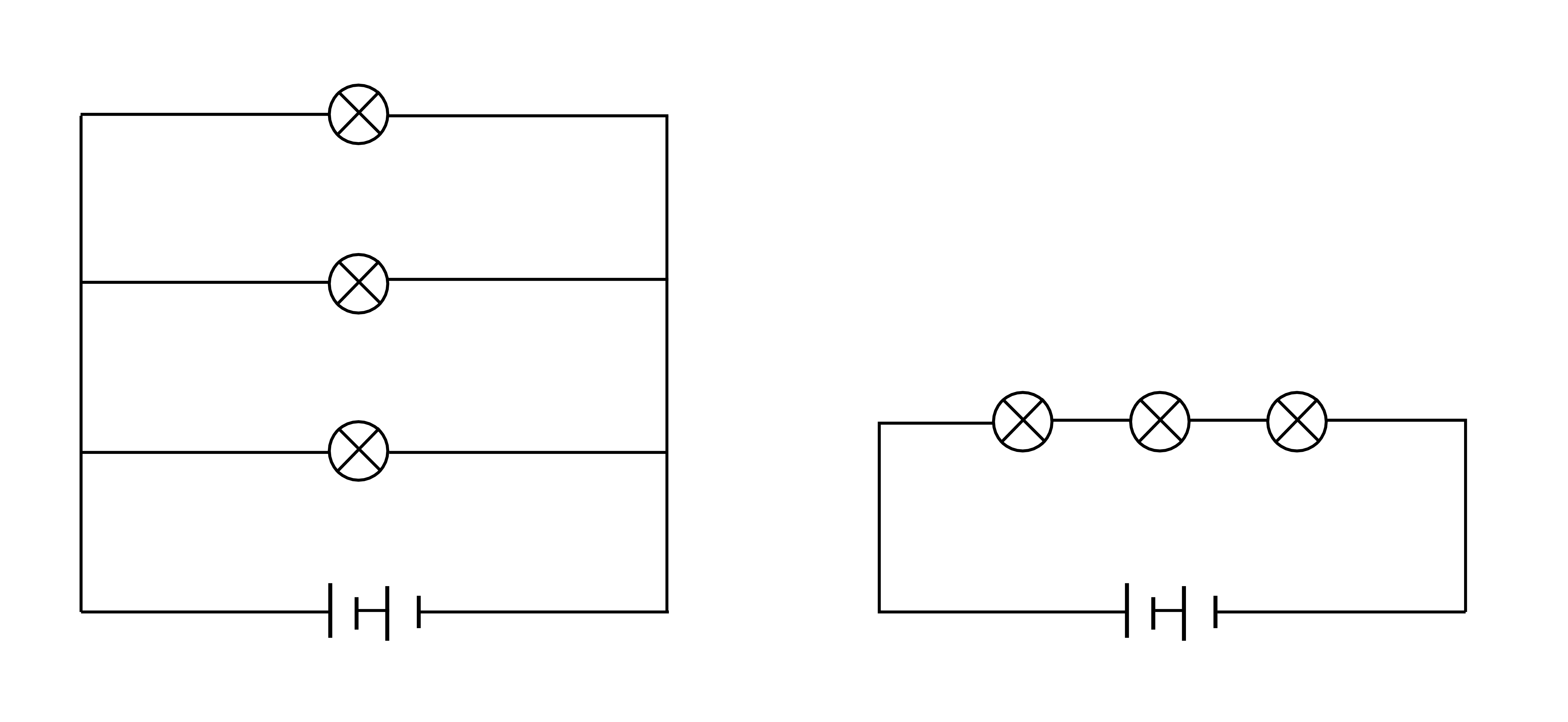
| Property | Series Circuit | Parallel Circuit |
|---|---|---|
| Current | Same everywhere $I_{total} = I_1 = I_2$ |
Splits at junctions $I_{total} = I_1 + I_2$ |
| Voltage | Shared between components $V_{total} = V_1 + V_2$ |
Same across each branch $V_{total} = V_1 = V_2$ |
| Resistance | Add up $R_{total} = R_1 + R_2$ |
Less than smallest $\frac{1}{R_T} = \frac{1}{R_1} + \frac{1}{R_2}$ |
Source: Wikimedia Commons

Example: Series Resistance
Two resistors (6 Ω and 4 Ω) are connected in series. Find the total resistance.
$R_{total} = R_1 + R_2 = 6 + 4 = 10$ Ω
$R_{total} = R_1 + R_2 = 6 + 4 = 10$ Ω
Example: Parallel Resistance
Two resistors (6 Ω and 3 Ω) are connected in parallel. Find the total resistance.
$\frac{1}{R_T} = \frac{1}{6} + \frac{1}{3} = \frac{1}{6} + \frac{2}{6} = \frac{3}{6} = \frac{1}{2}$
$R_T = 2$ Ω
Note: Total is less than the smallest resistor (3 Ω).
$\frac{1}{R_T} = \frac{1}{6} + \frac{1}{3} = \frac{1}{6} + \frac{2}{6} = \frac{3}{6} = \frac{1}{2}$
$R_T = 2$ Ω
Note: Total is less than the smallest resistor (3 Ω).
🧮 Resistance Calculator:
R₁:
Ω
R₂:
Ω
🎯 Series vs Parallel Quiz
Current-Voltage Characteristic Graphs
I-V graphs show how the current through a component changes as the voltage across it changes.
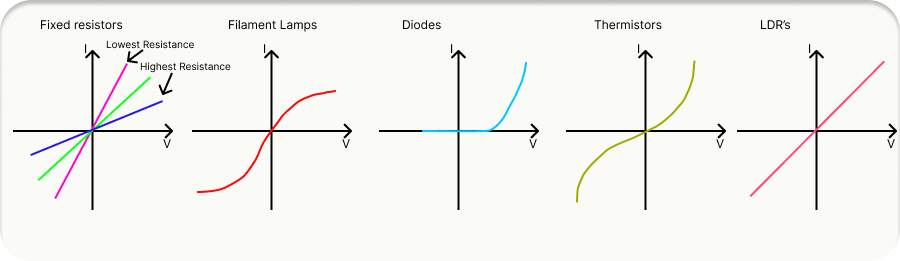
I-V graphs show how the current through a component changes as the voltage across it changes.
💡 Understanding I-V Graphs:
• Straight line through origin = Ohmic (constant resistance)
• Curve that flattens = Resistance increases with temperature
• Steeper line = Lower resistance (more current for same voltage)
• Gradient = 1/R (inverse of resistance)
• Curve that flattens = Resistance increases with temperature
• Steeper line = Lower resistance (more current for same voltage)
• Gradient = 1/R (inverse of resistance)
🎯 I-V Graph Quiz
Real Life Applications:
• Circuit breakers: Protect against too much current
• Dimmer switches: Change resistance to control brightness
• Phone chargers: Convert voltage for safe charging
• LEDs: Low resistance, need current-limiting resistor
• Household wiring: Parallel circuits so each device gets full voltage
• Circuit breakers: Protect against too much current
• Dimmer switches: Change resistance to control brightness
• Phone chargers: Convert voltage for safe charging
• LEDs: Low resistance, need current-limiting resistor
• Household wiring: Parallel circuits so each device gets full voltage